

 ChatGPT
 Claude
 Perplexity
 Gemini
Unlocking Efficiency, Safety and Growth in Australia’s Backbone Industry
Across Australia, construction and engineering businesses are gradually adapting to a changing landscape. As project demands evolve and workforce pressures continue, there’s a growing interest in smarter ways of working. Many are starting to see the benefits of embracing digital tools and automation to support smoother, more efficient project delivery.
This trend is reflected in recent findings from Deloitte Access Economics and Autodesk. Their 2025 State of Digital Adoption in the Construction Industry report highlights that Australian businesses are steadily building their digital capabilities, now using an average of 6.9 technologies—a notable increase from 5.3 the year prior. With a quarter of business expenditure now directed towards new technology, digital transformation is becoming part of the everyday conversation.
The Benefits of Going Digital Are Real and Measurable
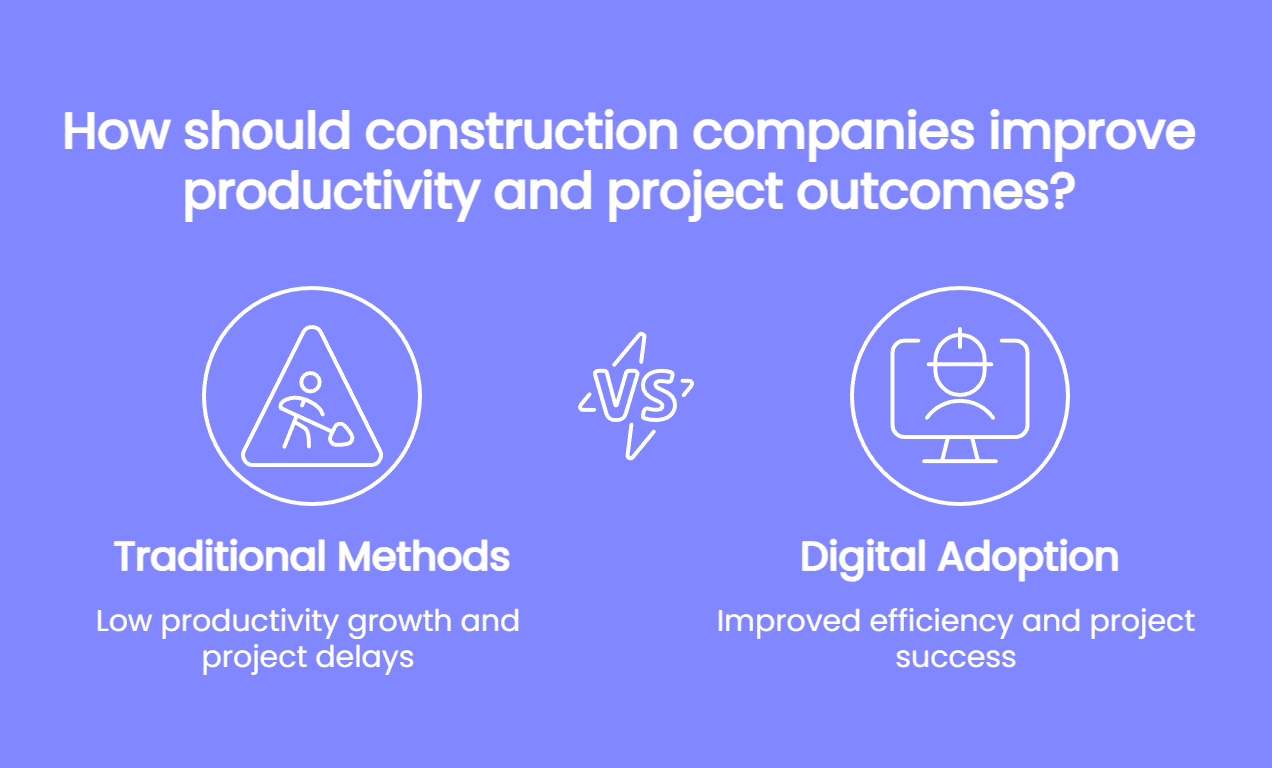
Adopting digital tools isn’t just about modernising for the sake of it—it’s increasingly recognised as a practical way to improve day-to-day operations. The McKinsey Global Institute notes that construction productivity has grown by just 1% annually over the past two decades, significantly lagging behind other sectors. But companies that adopt digital workflows—from scheduling software to data analytics platforms—are seeing real change.
Benefits reported across studies and surveys include:
- Greater project efficiency and more predictable timelines
- Improved visibility into site progress and team coordination
- Stronger decision-making through better data and analytics
- Reduced risk through early detection of errors or safety issues
Even incremental steps matter. Deloitte’s research found that adding just one new digital tool can improve on-time delivery and budget control. Similarly, KPMG’s Future-Ready Index highlights that digitally mature firms are 20% more likely to complete projects ahead of schedule and under budget. In a sector where delays are routine, these modest improvements can have a powerful ripple effect—freeing up time, reducing stress, and enhancing client confidence.
AI and Automation: Ready for Deployment
Interest in Artificial Intelligence (AI) and automation is on the rise in construction, and it’s not just hype. A growing number of businesses—72% across the Asia-Pacific region, according to Deloitte—plan to implement AI and Machine Learning tools to streamline their operations. These technologies are emerging as practical solutions for everyday challenges, offering ways to:
- Monitor site conditions and safety in real time
- Automate repetitive tasks such as reporting and documentation
- Detect design clashes or schedule risks early through predictive planning
A 2023 report by the World Economic Forum underscored AI’s potential in construction, noting that machine learning algorithms can cut project time by up to 20% and reduce costs by 15% through more accurate forecasting and planning. Closer to home, industry feedback in Australia shows that even basic AI-powered tools—such as defect detection software or smart scheduling apps—are helping teams reduce rework and accelerate progress by surfacing issues earlier in the process.
As adoption becomes more accessible, even smaller firms are beginning to see how targeted use of automation can lift productivity without overhauling their entire operation.
Related Article: AI Prompts for Digital Marketers
Change Management Is the Secret to Success
Despite the proven benefits, many businesses struggle with implementation. The report highlights that effective change management is the key to unlocking full ROI.
Most effective practices include:
- Clearly communicating the benefits to teams
- Piloting tech before full rollout
- Leadership actively using the new tools
- Allocating specific budgets for tech transitions
Companies that adopted multiple change management tactics were 20% more likely to increase their overall use of technologies. They also enjoyed a 3-point revenue boost over those that didn’t.
Addressing the Skills Gap in AI and Digital Tools
A persistent challenge is the lack of digital skills. In Australia, 85% of businesses reported difficulty in finding qualified candidates, with 51% uncertain about the technical skills required.
While upskilling existing teams and investing in user-friendly platforms are important steps, many businesses benefit most from partnering with specialists who can guide the way. Working with a trusted provider ensures you have not only the right tools but also a clear implementation plan and hands-on training to bring your team up to speed.
As an AI and automation agency, we help construction businesses:
- Identify the specific digital capabilities needed based on project goals
- Design a phased rollout plan that fits your resources and timelines
- Deliver tailored training to ensure confident, capable usage across your team
When technology is introduced thoughtfully and with the right support, the results can be transformative. For example, CPB Contractors digitised everything from concrete delivery to safety simulations, enabling faster project delivery, fewer manual errors, and smoother collaboration with clients and communities.
Smarter Systems, Safer Sites
Jobsite safety remains one of the most critical challenges in construction—and technology is making a measurable difference. Deloitte’s research found that businesses using six or more digital tools were 50% more likely to report a reduction in safety incidents. From BIM-driven safety modelling to wearables and IoT sensors that track environmental conditions, technology is helping teams anticipate risks, take faster action, and reduce manual paperwork that can delay interventions.
These findings are supported by the World Economic Forum, which notes that digital platforms are enabling safer construction practices globally, and by McKinsey, which reports that data-rich safety systems can reduce incident rates by up to 20% through predictive analysis and real-time monitoring.
Technology is also playing a role in building more inclusive workplaces. The Deloitte study found that companies using more digital tools were 22% more likely to report an increase in female participation. Tools that support remote collaboration, flexible scheduling, and task automation help reduce traditional barriers—creating space for a more diverse workforce to thrive in construction roles.
Don’t Let Legacy Systems Hold You Back
Legacy systems are more than just outdated—they’re holding businesses back. According to Deloitte, the average construction firm juggles 11 different data environments, often inherited over time and rarely designed to work together. This fragmentation leads to duplicated effort, siloed communication, version control issues, and unnecessary admin overhead.
The impact is well-documented. Research from PlanGrid and FMI reveals that construction professionals spend 35% of their time on non-optimal activities—searching for project data, correcting errors, or managing rework. And according to McKinsey, integrating systems through digital collaboration platforms can reduce project delivery time by up to 20%.
Migrating to a Common Data Environment (CDE)—a central hub where data flows securely and seamlessly across teams—can streamline operations significantly. Deloitte’s 2025 report estimates that this shift alone could save project managers up to 1.5 days per week. For small to mid-sized firms, that’s time reclaimed to focus on delivery, not firefighting.
The Case for a Strategic Automation Roadmap
Whether you’re a small contractor or a growing mid-sized firm, creating a clear plan for automation can help reduce inefficiencies, unlock capacity, and future-proof your operations. A strategic roadmap ensures technology investments are aligned with your business goals and delivered in manageable, practical stages.
According to McKinsey, companies with a structured digital transformation plan are 2.5 times more likely to succeed than those without one. And a recent Autodesk/FMI study found that firms with defined digital strategies outperform peers in cost control, schedule reliability, and client satisfaction.
At Spark, we work closely with construction businesses to turn digital ambition into practical action:
• Audit your current tech stack
• Identify automation opportunities
• Develop a tailored, step-by-step implementation roadmap
Book a Strategic Workshop
Want to find out how your construction business can move faster, smarter and safer?
Find out about a Strategic Workshop with our team. We’ll show you what automation can unlock for your business.
Sources:
- Deloitte Access Economics & Autodesk, State of Digital Adoption in the Construction Industry 2025
- McKinsey Global Institute, Reinventing Construction: A Route to Higher Productivity, 2017
- World Economic Forum, AI in Construction: Enhancing Productivity and Safety, 2023
- KPMG – Future‑Ready Index 2023: Leaders and Laggards in the Construction Industry
- PlanGrid & FMI – Construction Disconnected Report, 2018
- Autodesk & FMI – Digital Strategy and Transformation in Construction, 2023