

 ChatGPT
 Claude
 Perplexity
 Gemini
Most people thinking about working with you will look at your website before they ever speak to you. And for many of them, your careers page is where they really decide whether to take you seriously as a potential employer.
In a lot of small and mid sized businesses, the careers page is treated as an admin space: a list of roles, maybe a generic paragraph about culture, and a button to apply. In reality, it can do much more. It can give people a real feel for your culture, values and growth story, and help the right candidates recognise that they belong with you.
This article looks at how to shift your careers page from a job list to a clear, human expression of what it is like to work in your business – and then walks through two real-world examples we think do this well.
From vacancy list to story
A careers page that is just a list of roles forces candidates to piece together what you are like as an employer from scattered clues. A stronger approach is to treat it as a page with a story:
- Who you are and what you do
- How you work together
- What kind of people thrive with you
- How people can grow, contribute and be supported
That doesn’t mean long, flowery copy. It means a few clear paragraphs that answer the questions people actually have in their heads:
- “What sort of work will I be doing here?”
- “Who will I be working with?”
- “Is this more corporate, more entrepreneurial, more technical, more creative?”
- “Will I be stretched and supported, or left to sink or swim?”
If your careers page currently jumps straight into open roles, consider adding a short section above them that simply tells this story in plain, confident language.
Bringing culture and values to life
Culture and values can easily become vague words on a poster. On a careers page, they are far more powerful when they show up in practical, concrete ways.
a) Plain-language values
Values do not need to sound corporate. In fact, they work better when they are written in everyday language and linked to real behaviour.
Instead of “We value excellence”, you might say:
- “We take care with details”
- “We do what we say we will do”
- “We are honest when things go wrong”
You can go one step further by adding a short line about what each value looks like in practice – for example, how it shapes the way you work with clients or with each other. This helps candidates picture how those values show up day to day, not just in a slide deck.
b) Real team voices
Candidates want to hear from people who already work with you. Real voices make your careers page feel human rather than scripted.
That might include:
- A short quote from your founder or leader about why they built the business and how they want people to feel at work
- A couple of staff quotes about why they joined and what has kept them there
- A simple “day in the life” snapshot for a key role
You do not need dozens of profiles. Even one or two specific voices – with names, roles and a sentence or two in their own words – can make a big difference.
c) Showing growth and support
For many people, the real question is not “What is the job?” but “Where can this job lead?” and “Will I be supported on the way?”
Your careers page is a good place to:
- Explain how you help people develop (mentoring, training, exposure to different work)
- Talk about how progression works, even if it is informal
- Show how you support wellbeing and balance, not just performance
This is particularly important for smaller businesses, where the opportunity often lies in variety, autonomy and access to decision-makers. If those are strengths, say so.
Design and experience: making it easy to say “Yes, this is me”
Good content needs good structure. A strong careers page is easy to scan and easy to act on.
Consider:
- A clear, simple layout
Use headings such as “Who we are”, “How we work”, “What we offer” and “Current opportunities”. Break text into short sections so people can scan quickly. - Different paths for different visitors
Some visitors just want to see open roles. Others are curious about your culture but not yet ready to apply. Make it easy for both: link clearly to job ads, and offer an option to express interest or join a talent pool even if no roles are listed. - On-brand visuals
Use photography and design that feel consistent with the rest of your site so it is clearly part of the same brand. Real team photos (where possible) help more than generic stock. - Mobile friendly and low friction
Make sure the page works well on mobile, and that applying does not mean battling with a long, clunky form. The easier it is to express interest, the more likely good people are to do it.
A useful test is to open your careers page on your phone and see how quickly you can answer three questions: What kind of work is this? What kind of people are they? How do I take the next step?
Two examples we admire
Rather than a blow-by-blow breakdown, think of these as two different ways of doing the same thing well: using the careers page to show culture and values in action.
Both are quite different organisations, but they share some useful patterns you can borrow, which we will highlight alongside screenshots.
Kreisson – high performance and specialist expertise
Kreisson is a specialist construction and engineering law firm. Their Careers & Culture page leads with a clear description of what they are like as a team: built on deep expertise, shaped by sharp minds and high standards.
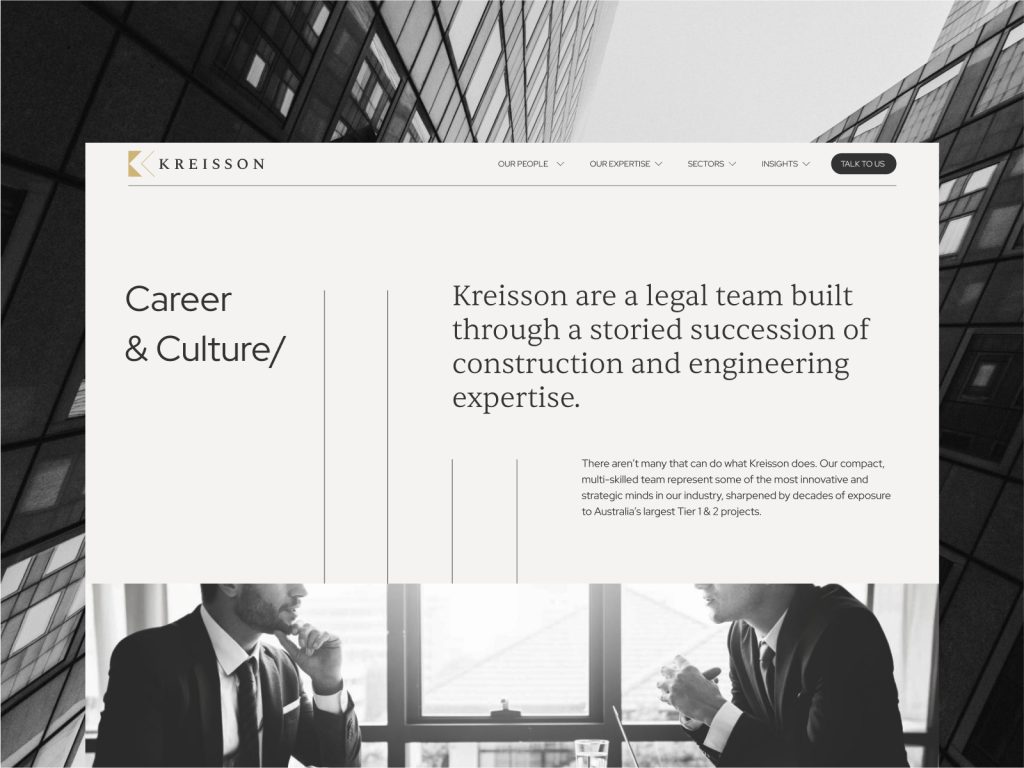
A few things stand out:
- A concise opening story
In a couple of paragraphs, they explain their culture as precise, commercial and strategic, and describe working as a compact, multi skilled team on complex matters. It quickly sets expectations about pace, standards and type of work. - A considered “What you can expect” section
Instead of a generic benefits list, they spell out what people can expect: real development, a collaborative environment, smart systems, flexibility that supports performance and accessible leadership, each with a short explanation. - Values connected to behaviour
Values such as “Excellence in Delivery”, “Integrity in Action” and “Accountability in Ownership” are named and then briefly unpacked in terms of real behaviour – what that means for clients and for colleagues. - Purpose and community
Sections on giving back and professional memberships show community involvement and industry participation. It signals that the firm cares about more than billable hours.
It is a good example of how a specialist firm can talk openly about high standards while also signalling that people will be supported to do their best work.
MU Group – people, growth and belonging
MU Group works on transport and infrastructure projects, and their careers page starts by connecting the work to “infrastructure projects that are shaping our future”. It immediately links roles to impact.

What they do particularly well:
- People-first language
A section headed “Join a team devoted to its people” makes it clear that the company recognises the team behind each project and values diverse backgrounds and experiences. The language is warm and direct. - Benefits grouped into clear themes
Rather than listing perks, they group benefits into themes such as Family & Wellbeing, Professional Development and Culture & Interest Groups, with a short explanation under each. It feels like a joined-up approach rather than a scattered list. - Early-career stories
Intern and graduate stories, with names and short descriptions, make early career paths concrete and relatable. It is easy for students and graduates to imagine themselves following a similar route. - A welcoming invitation to connect
A closing section invites people at different stages of their career to get in touch, even if there is not a specific open role that fits them right now. It signals genuine interest in great people, not just box-ticking against job descriptions.
This is a strong example of how an engineering-led organisation can still talk clearly and humanly about people, support and community.
Quick checklist: is your careers page doing its job?
You can use this short checklist to review your own page:
- Does it clearly explain who you are and what you do?
- Can someone quickly understand your culture and values, in plain language?
- Are there real team voices or stories on the page?
- Do you show how people are supported to grow and develop?
- Is the page visually aligned with the rest of your brand?
- Is it easy to see current opportunities and how to apply?
- Can a good person express interest even if there is no perfect role listed?
If you are missing more than a couple of these, you do not need to fix everything at once. Start by tightening the story at the top of the page, then add one real voice and one clearer section on growth or benefits.
Where Spark can help
For many businesses, the careers page has not had the same attention as the homepage or key service pages. By treating it as a core part of your brand, you can attract better aligned candidates and make it easier for the right people to choose you.
At Spark Interact, we help small and mid sized organisations bring their culture and values to life across their website and online presence, including careers and culture pages. If you would like a light review of your own careers page, or support to shape a stronger employer story across your site, socials and campaigns, we would be happy to explore that with you.