
 ChatGPT
 Claude
 Perplexity
 Gemini
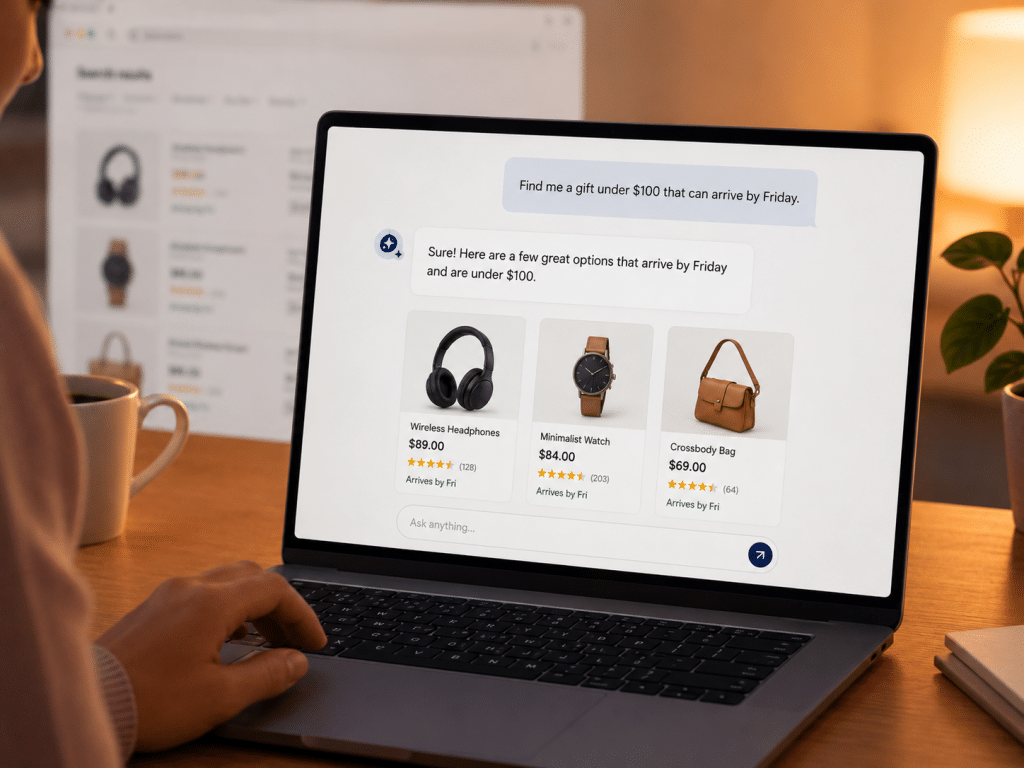
A customer needs a gift by Friday.
Instead of searching Google, opening ten tabs, comparing products, reading reviews, checking delivery times, and deciding which store to trust, they ask an AI assistant for help.
The AI finds relevant options, compares the details, checks availability, answers follow-up questions, and narrows the choice before the customer ever lands on a website.
That is the shift behind agentic commerce. It is not just another way to describe online shopping. It points to a change in how products may be discovered, compared, and purchased in the near future.
For ecommerce businesses, this matters because the first layer of product discovery may no longer start with a person browsing your website. Your product pages, category structure, brand messaging, reviews, delivery information, returns policy, and broader digital presence may be interpreted by an AI system before a customer ever decides whether to visit your store.
That changes what it means to be visible.
What agentic commerce actually is
Agentic commerce is a new way of shopping where AI agents help consumers discover, compare, and purchase products through a conversation.
In a traditional ecommerce journey, the customer does most of the work. They search for a product, browse different stores, compare options, read product pages, check prices, review shipping details, and decide whether to buy. In an agentic commerce journey, an AI assistant can handle some of those steps on the customer’s behalf.
A shopper might ask an AI tool to find a suitable birthday gift for a 10-year-old who likes art. The AI can search through available product information, consider the shopper’s budget and preferences, suggest options, and refine the results when the customer asks for something cheaper, faster to deliver, or more specific.
The customer is still part of the decision, but the AI is doing more of the early searching and filtering.
Shopify’s article explains this through ecommerce platforms and AI shopping channels. Products can now be surfaced through AI conversations on platforms such as ChatGPT, Microsoft Copilot, Google AI Mode, and Gemini. In some cases, the customer may be guided through to the merchant’s checkout. In others, the purchase journey may happen inside the AI experience itself.
The important part is not only the checkout. It is the discovery stage. If AI tools are helping customers decide what to consider, ecommerce businesses need to think about how their products are understood by those tools.
AI agents do not browse like people

A human shopper may respond to a beautiful homepage, a lifestyle image, a clever headline, or a well-designed product grid. Those things still matter because people still need to feel confident in the brand and comfortable buying from it.
But AI agents do not browse a store in the same way.
They rely on information they can access, read, interpret, and trust. That includes product titles, descriptions, images, pricing, inventory, shipping details, size options, product attributes, customer reviews, policies, FAQs, and brand information.
If that information is clear and complete, the product has a better chance of being understood correctly. If the information is vague, inconsistent, outdated, or missing important details, the AI may not be able to represent it well.
This is where ecommerce visibility starts to change.
In traditional search, businesses have spent years thinking about SEO. That usually means making sure pages are crawlable, keywords are relevant, metadata is useful, and content answers what people are searching for.
Agentic commerce adds another layer. Your product data and store content may need to support AI-driven discovery, not just search engine results. A customer may not type “best ceramic dinner set Australia” into Google. They may ask an AI assistant, “Find me a durable dinner set for a young family that looks nice enough for guests but is not too expensive.”
That kind of query is more conversational, more specific, and more dependent on context. It requires the AI to understand product attributes, use cases, audience fit, price sensitivity, brand trust, and delivery details.
If your product page simply says the dinner set is “stylish and high-quality”, that may not be enough.
Product pages need to answer better questions
Ecommerce product pages often focus on selling to the human reader. That is still necessary, but product pages also need to become stronger sources of information.
A good product page should clearly explain what the product is, who it is for, what problem it solves, what makes it different, and what a customer needs to know before buying. It should not rely only on broad claims like premium, versatile, durable, or must-have.
Those words can help shape tone, but they do not give an AI agent much to work with.
For example, a skincare product page should not only say the product leaves skin feeling refreshed. It should explain the skin type it suits, the texture, when to use it, how it fits into a routine, what ingredients matter, and any relevant cautions. A furniture product page should not only describe the item as modern or elegant. It should include dimensions, materials, care instructions, delivery details, assembly requirements, weight capacity, and room suitability.
The more specific and structured the information is, the easier it becomes for both people and AI tools to understand where the product fits.
This does not mean turning every product page into a technical manual. It means removing guesswork. If a customer would naturally ask a question before buying, the page should probably answer it.
Category pages may become more important
Product pages are only one part of the picture. Category pages also matter because they help organise how products relate to each other.
A strong category page does more than display a grid of items. It helps customers understand the range, compare options, and find the right starting point. It can explain product types, use cases, materials, price ranges, sizing considerations, popular choices, or buying factors.
That kind of structure can also help AI systems interpret the store.
If your category pages are thin, generic, or almost identical across the site, they may not give enough context. If they are clearly written and organised around real customer needs, they become more useful.
For example, a category page for office chairs could explain the difference between ergonomic chairs, task chairs, executive chairs, and home office chairs. It could mention what to consider for long workdays, adjustable features, materials, and delivery options. That gives shoppers more confidence, but it also gives AI tools clearer information to draw from when someone asks for a recommendation.
This is where ecommerce content and customer experience overlap. Better structure helps people shop more easily. It also helps digital systems understand the store more accurately.
Brand trust still matters, but it needs to be clearer
Agentic commerce does not remove the need for brand. If anything, it makes brand clarity more important.
When an AI agent recommends a product, it may need to explain why one option is worth considering over another. That explanation may draw from product information, reviews, policies, availability, price, delivery, and broader trust signals.
If your brand is unclear, inconsistent, or overly generic, it becomes harder to represent.
This is not about making the brand louder. It is about making the brand easier to understand. What do you sell? Who is it for? Why should customers trust you? What kind of experience do you provide? What promises can you genuinely support?
A brand that relies only on broad language may struggle. Phrases like “quality products at great prices” do not give much distinction. Almost every ecommerce business can say the same thing.
A clearer brand might communicate that it specialises in long-lasting school supplies for busy families, Australian-made skincare for sensitive skin, practical workwear for trades, or premium event furniture for commercial venues. The more specific the position, the easier it is for customers and AI systems to understand when the brand is relevant.
This is also why businesses should avoid treating AI as separate from brand strategy. As more customer journeys become shaped by AI tools, an AI-informed brand journey becomes less about chasing new technology and more about making sure the brand can be understood consistently wherever customers encounter it.
Policies and FAQs are part of the buying decision
One of the practical points in Shopify’s article is that AI agents may answer customer questions using store information such as return policies, shipping details, and FAQs.
That matters because these details can make or break a sale.
A customer may ask whether an item can arrive before the weekend. They may ask whether returns are free. They may ask whether a product comes in a specific size, whether it suits a particular use, or whether the store ships to their location.
If the AI tool cannot find a clear answer, it may give a vague response, recommend another product, or push the customer towards a store with better information.
That means operational content is not just admin copy. Delivery pages, returns policies, product FAQs, warranty information, care instructions, and contact details all contribute to trust.
For ecommerce businesses, this is a useful reminder. Some of the most important content on a site is not always the most glamorous. Customers often look for practical reassurance before they buy. AI agents may do the same.
Clear policies reduce friction. Clear FAQs reduce doubt. Clear product information reduces the chance of confusion after purchase.
Consistency across your store matters
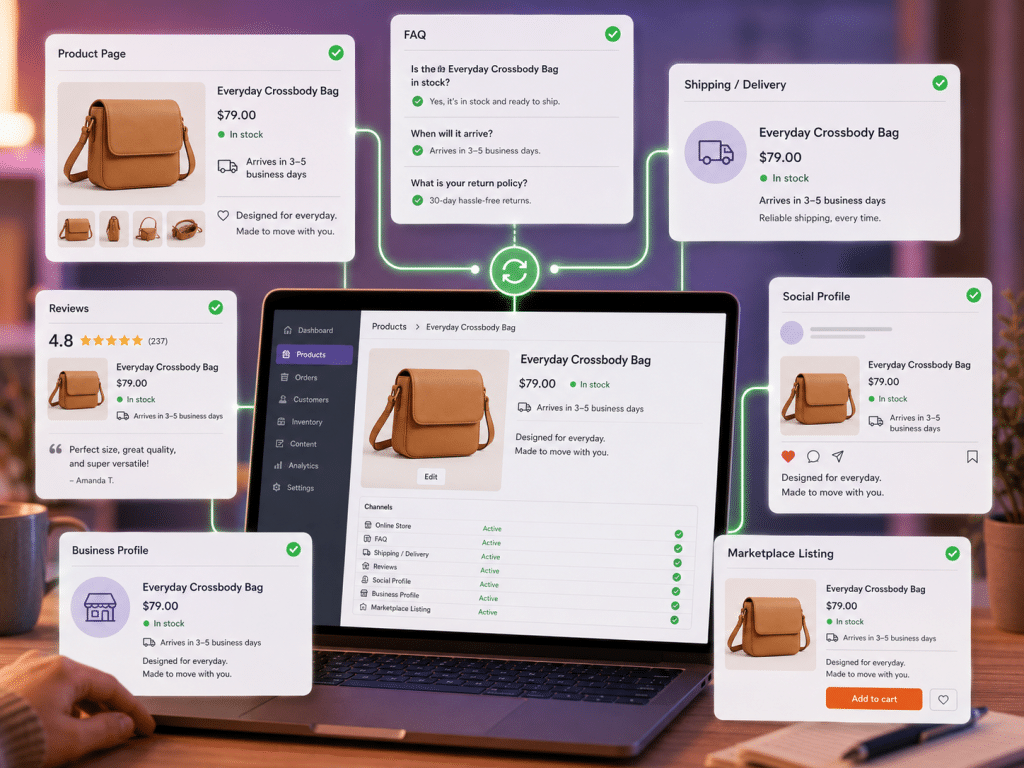
AI agents may pull information from different parts of your digital presence. That could include product pages, category pages, FAQs, policy pages, reviews, social profiles, Google Business Profile, marketplace listings, and other indexed content.
If those sources tell different stories, the result can become messy.
A product description might say an item is suitable for outdoor use, while an FAQ says it should only be used indoors. A delivery page might say standard shipping takes three to five business days, while a product page still mentions an outdated delivery estimate. A brand might promote itself as Australian-owned in one place but fail to explain its fulfilment, sourcing, or local support anywhere else.
For a human customer, these inconsistencies create doubt. For an AI tool, they can create uncertainty.
That does not mean every page needs to repeat the same wording. It means the information needs to align. Product details, policies, brand claims, service promises, and customer support information should all point in the same direction.
This also applies when businesses start using AI internally. If your team uses AI to help write product descriptions, respond to customers, prepare campaigns, or generate FAQs, clear guardrails help reduce the risk of incorrect claims, inconsistent tone, or off-brand messaging.
The more AI becomes part of ecommerce, the more important it becomes to control the information it uses.
Automation is not only happening behind the scenes
Many ecommerce businesses already think about automation in practical operational terms. They use it to manage orders, inventory, reporting, email flows, fulfilment, customer service, and internal admin.
That work is still important. When disconnected systems slow down delivery, the issue is often that the systems are not talking, not that the team is moving too slowly.
But agentic commerce points to another side of automation. Automation is not only changing how businesses operate. It is also changing how customers discover and choose.
That means ecommerce businesses need to look beyond internal efficiency. The customer journey itself is becoming more automated. Search, comparison, recommendations, product questions, and purchase decisions may increasingly happen through AI-assisted experiences.
This does not mean every ecommerce business needs to rebuild its store around AI tomorrow. It does mean the foundations need to be stronger.
Product data needs to be accurate. Category structures need to make sense. Product descriptions need to be useful. Policies need to be easy to find and understand. Reviews and trust signals need to support the decision. Brand messaging needs to be consistent. The website needs to work for both human shoppers and the systems helping them shop.
These are not trend-driven tasks. They are the basics of ecommerce readiness.
What ecommerce businesses should review now
The most practical response to agentic commerce is to review whether your store can be clearly understood.
Start with your product pages. Do they answer the questions customers usually ask before buying? Are the titles specific? Are the descriptions useful? Are key attributes included? Are images labelled and relevant? Are sizes, materials, ingredients, dimensions, compatibility details, or care instructions easy to find?
Then look at your category pages. Do they help customers compare options, or do they only display products? Are categories organised around how people actually shop? Do they provide useful context for different needs, budgets, product types, or use cases?
Then review your policies and FAQs. Are delivery timeframes clear? Are returns and exchanges easy to understand? Are warranty terms explained? Are common customer objections answered before they become barriers?
Finally, look at your brand presence. Does your website explain who you are and why customers should trust you? Are your claims specific and supported? Is your messaging consistent across your store, social channels, Google profile, email campaigns, and customer service responses?
These questions are not only about AI. They are about making the store easier to shop from.
The useful thing about preparing for AI-driven discovery is that the same improvements often help human customers too. Clearer product information reduces doubt. Better category structure improves navigation. Stronger policies build trust. Consistent messaging makes the brand easier to remember.
The businesses that become easier for AI agents to recommend are likely to be the same businesses that are already easier for customers to understand.
The rules of product discovery are changing
Agentic commerce is still emerging, and it would be a mistake to overstate how quickly every customer behaviour will change. People will still browse websites. They will still search Google. They will still scroll social media, read reviews, ask friends, and compare products manually.
But the direction is worth paying attention to.
As people become more comfortable asking AI tools for recommendations, some product discovery will move away from the traditional website-first journey. Customers may not always start by visiting your store. They may start with a question inside an AI assistant.
That means your products need to be understandable before the customer arrives. Your brand needs to be credible before they click. Your policies need to be clear before they ask. Your content needs to give AI tools enough accurate information to represent your business properly.
This is not about chasing the newest ecommerce trend. It is about recognising that the way people find and compare products is changing.
For ecommerce businesses, the goal is simple: make your store easier to read, easier to trust, and easier to recommend.
Because before a customer adds to cart, an AI assistant may already have narrowed the options.
The real question is whether your products will still be in the list.