
 ChatGPT
 Claude
 Perplexity
 Gemini
The first few weeks of a new financial year often get swallowed by review, recovery and catch-up.
They review the numbers. Chase up loose ends. Wait to see how the first quarter settles. Push marketing decisions into “later”, because everyone is still recovering from June.
That delay feels sensible. It usually isn’t.
1 July is not just a line in the accounting calendar. It is a starting gun. The businesses that build momentum in FY2027 will not be the ones who wait until January to reset. They will be the ones who lock in their direction now, while competitors are still deciding what to do next.
The cost of going quiet
When business conditions feel uncertain, marketing is often one of the first things to pause.
On paper, that can look like a cost-saving decision. In practice, it can create a revenue problem that takes months to unwind.
Businesses that cut or stall marketing during uncertain periods face an average 23% revenue decline in year one. Once brand visibility drops, it can take 6 to 9 months to rebuild the position you had before.
That is not a motivational argument. It is a financial one.
If your business disappears from the market for a quarter, customers do not stop making decisions. They compare other providers. They respond to other offers. They build familiarity with competitors who kept showing up.
There is also an opportunity on the other side. When competitors go quiet, cost-per-lead can drop by around 40%. That means the businesses that stay active may be able to generate attention and enquiries at a lower cost while everyone else is holding back.
This is why early July matters.
A new financial year marketing strategy in Australia should not start with “what should we post?” It should start with a more commercial question:
Where can marketing create measurable revenue this quarter?
What a 2027 marketing strategy actually looks like
For small to medium businesses, a strong marketing strategy should answer three commercial questions:
- Where should we invest first?
- What activity is most likely to generate revenue?
- How will we know if the spend is working?
Spark Interact’s approach is built around those principles. While a comprehensive marketing strategy sets your overarching direction for the entire 12 months of FY2027, locking yourself into a rigid, unchangeable yearly roadmap is a trap—especially when the 2026 Federal Budget’s $10.2 billion regulatory shake-up means the business landscape is shifting rapidly.
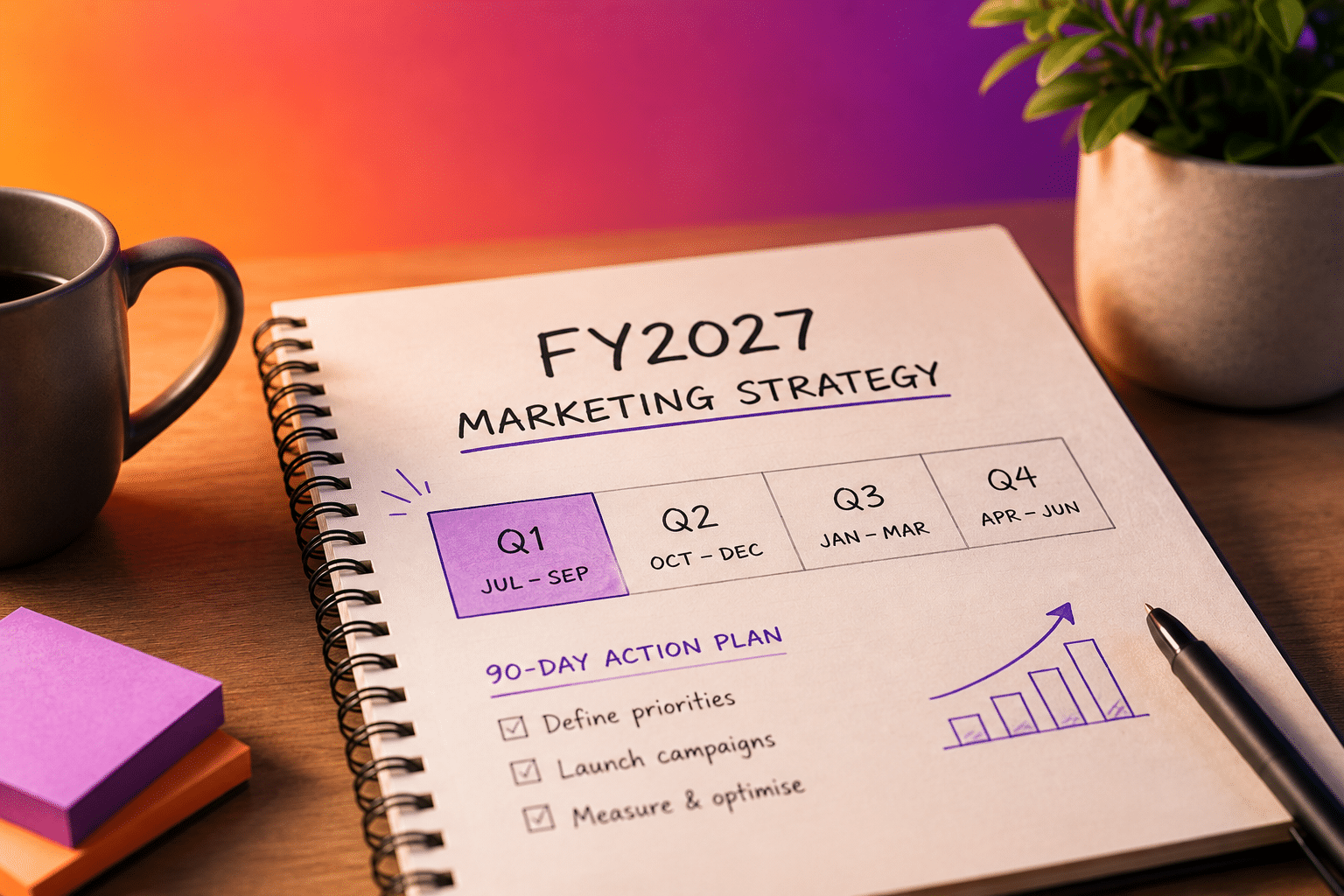
Instead, we break your annual strategy into highly agile, 3-month action plans. This gives you the best of both worlds: a clear long-term vision for the year ahead, combined with the short-term speed to pivot when the market moves and the strict quarterly accountability to measure exactly how your investment translates into bottom-line revenue.
That plan includes:
- channel selection, so your budget goes where it has the strongest commercial case
- audience insights, so your messaging speaks to the right buyers
- a campaign calendar, so activity is planned before the quarter disappears
- a KPI framework, so performance is tied to revenue targets
- quarterly reviews, so the strategy keeps improving instead of sitting untouched
That means performance is not assessed through impressions, clicks or vague engagement metrics alone. Recommendations are framed through return on investment, pipeline value, customer acquisition cost and payback period.
This is planning that speaks CFO language. Here is exactly how that 12-month vision and 90-day execution work together throughout the year:
How the 90-day plan fits into FY2027
| Period | Purpose | What it does |
| July to June | 12-month FY2027 strategy | Sets the bigger direction for the year: target audience, channels, budget priorities, revenue goals and campaign themes. |
| July to September | First 90-day action plan | Turns the strategy into immediate activity. This is where Spark decides what to launch first, what to test, and what needs to produce results early. |
| End of September / early October | First quarterly review | Checks what worked, what did not, and what needs to change before the next quarter. |
| October to December | Next 90-day action plan | Adjusts the strategy based on real performance, market changes and new business priorities. |
The commercial models that remove the risk
One of the biggest reasons businesses delay marketing is risk.
They are not always saying no to growth. They are saying no to open-ended retainers, unclear deliverables and reports that do not prove whether the investment is working.
That is why Spark Interact’s 2027 Marketing Strategy Plan is built around flexible commercial models.
A Performance Retainer gives businesses a structured way to invest in marketing with accountability built in. The focus is not simply activity. It is performance against agreed commercial targets, with regular reviews to assess what is working, what needs to change and where the next opportunity sits.
A Micro-Retainer is designed for businesses that want a smaller, lower-risk entry point. With a monthly investment of $500 to $1,500, it focuses on one channel, one goal and a clear outcome. The aim is to prove ROI within 60 days before expanding the scope.
A Deferred Payment option allows eligible businesses to start now and pay in 60 to 90 days. For owners who know they need to act but want breathing room after EOFY, this removes one of the most common reasons to delay.
The point is simple: waiting is not the only way to manage risk.
If the model is structured properly, your business can start building momentum now without committing blindly to a large, untested marketing spend.
What the numbers look like
Here is the part most marketing conversations avoid.
For a business investing $4,500 to $6,500 per month, conservative modelling shows a return of $9 to $17 for every dollar spent in attributed revenue.
That matters because a marketing strategy should not be judged by whether it looks impressive in a presentation. It should be judged by whether the numbers make sense.
If the plan cannot explain the likely return, the pipeline opportunity and the payback period, it is not a strategy. It is a guess.
And guessing is expensive.
Start with a free Revenue Audit
Before you lock in your FY2027 marketing plan, get clear on what your current spend is actually returning.
Spark Interact’s free 30-minute Revenue Audit reviews your marketing spend, identifies revenue leaks, benchmarks your customer acquisition cost and gives you three practical actions to take next.
No pitch. No obligation. Just a clearer view of where your marketing can work harder this financial year.
Only five audit spots are available each month.
Book your free Revenue Audit: sparkinteract.com.au/audit