
 ChatGPT
 Claude
 Perplexity
 Gemini
If a customer asks AI about your business today, would you trust the answer?
Is it accurate? Does it say what you actually do? Is it complete, and does it mention all your products and services? And does it describe your business the way you’d describe it?
That’s the question I opened our Spark Festival 2026 webinar with on 22 September. Here’s what we covered, written down for anyone who missed it. The full recording is below.
First, ask AI about your business
Before you read on, open ChatGPT, Claude, Gemini or Perplexity on your phone. Start a new chat, because an old chat already knows you and that changes the answer. Then ask it one simple question:
“Who would you recommend for [your service] in [your suburb]?”
In the webinar I asked ChatGPT, “Who would you recommend for web design services in Sydney?” It gave me five agencies, and Spark Interact was one of them. That’s great. But your answer will probably fit one of four outcomes:
- Not mentioned. You don’t appear anywhere in the answer.
- A competitor instead. AI says you should go with another business.
- Mentioned, but wrong. It found you, but got your location, your phone number or your services wrong.
- Mentioned, and right. It got everything right.
Remember which one you got. We’ll come back to it at the end.
How AI builds an answer

When your customers look for a product or a service, they have a lot of questions, and they look for answers in a lot of places. They might ask Google for the “best roofing company near me”. They might ask ChatGPT who they should use. They read Reddit to see what other people say. They watch YouTube reviews, the same way you’d watch a video review before you buy a new car. And if it’s a professional service, they might check LinkedIn to see if that person has the right experience.
So your customer may check your business in many places before they ever contact you.
Here’s the big change. With a traditional search engine, Google crawls your website, indexes the pages and ranks them. When you ask a question, it gives you ten links and you click through to find the answer yourself.
An AI assistant works differently. First it works out what you mean. Then it collects the information that matches. Then it puts that together into one answer and gives it back to you.
One question becomes many. When you ask “Who would you recommend for web design in Sydney?”, the AI doesn’t ask one question. It also looks for a list of web design companies in Sydney, what makes a good web designer, and more. For each of those, it looks for answers in different places.
It works with the parts of a page that are most relevant to the question. When it finds useful information, it pulls out the passages that best match what the person is asking rather than treating your whole website as one answer.
It weighs those pieces, then builds an answer. The information it finds is assessed against the question before the most relevant pieces are brought together into the response you see.
That means you now have two audiences. People can take in the overall feel of a page. AI relies much more on what is clearly stated and how well that information connects to the question. What does this business do? Does that match what the customer asked? And what evidence supports the claim?
AI looks far beyond your website
We did some research for one of our clients’ industries. In August 2026 we looked at 17,626 citations in AI answers for one Australian manufacturing industry. Here’s where the answers came from:
- YouTube: 60.5%
- Google: 23.5%
- Reddit: 15.2%
- Wikipedia: 13.2%
- Facebook: 7.0%
- The best supplier website in the whole industry: 0.5%
One answer usually quotes several sources, so these don’t add to 100. And that’s one industry, not every industry. But it shows how widely AI can look for information. If you only focus on your website, you may be missing many of the other places AI can use to understand and validate your business.
Think of AI as a researcher on the clock
I know that can sound technical. So let’s take a step back. Here’s how I think about it.
Imagine AI is a researcher who works around the clock. Every time someone asks a question, it goes onto a board. The researcher takes a question from the board, and they have a budget and a deadline to answer it.
Why a budget? Because every answer uses real computing resources. Google measured its own median text question in 2025 at about 0.24 watt-hours of electricity and 0.26 mL of water. That sounds small, but at scale those costs add up, so AI systems need to find and process information efficiently.
That’s where the idea of cost of retrieval comes in: the effort involved in finding and using the information needed to answer a question.
So depending on the question, the researcher takes a different path. Here are two questions that sound similar, for a physio clinic in Newtown.
“Do you recommend [the clinic’s name]?”
Here the customer has mentioned the business, so the researcher goes to the business. Picture them walking up to the shop. One of three things happens:
- The door is shut. Some websites block AI from reading them, often through a security setting nobody chose. If it can’t get in, it can’t give a correct answer.
- The building has ten floors and no signs. The website is open, but it’s complex, and the answer is hidden somewhere inside. That makes it much harder to give a complete, accurate answer.
- The answer is right there at the front. The researcher reads it and takes it straight back to the customer. See how easy that is? That’s the one to aim for.
“Who is the best physio in Newtown?”
Now imagine you’re the researcher, and you have about ten seconds. What do you do? You don’t have time to visit every physio’s website. So you go to a list that someone else has already put together. You read it, and you check one thing: did this list come from a source I can trust?
If it did, you give the answer straight to the customer. You never visit a single clinic’s website.
So here’s the key idea:
You’re not competing for a rank. You’re competing to be the easiest business for AI to check.
What makes AI mention you: the three C’s
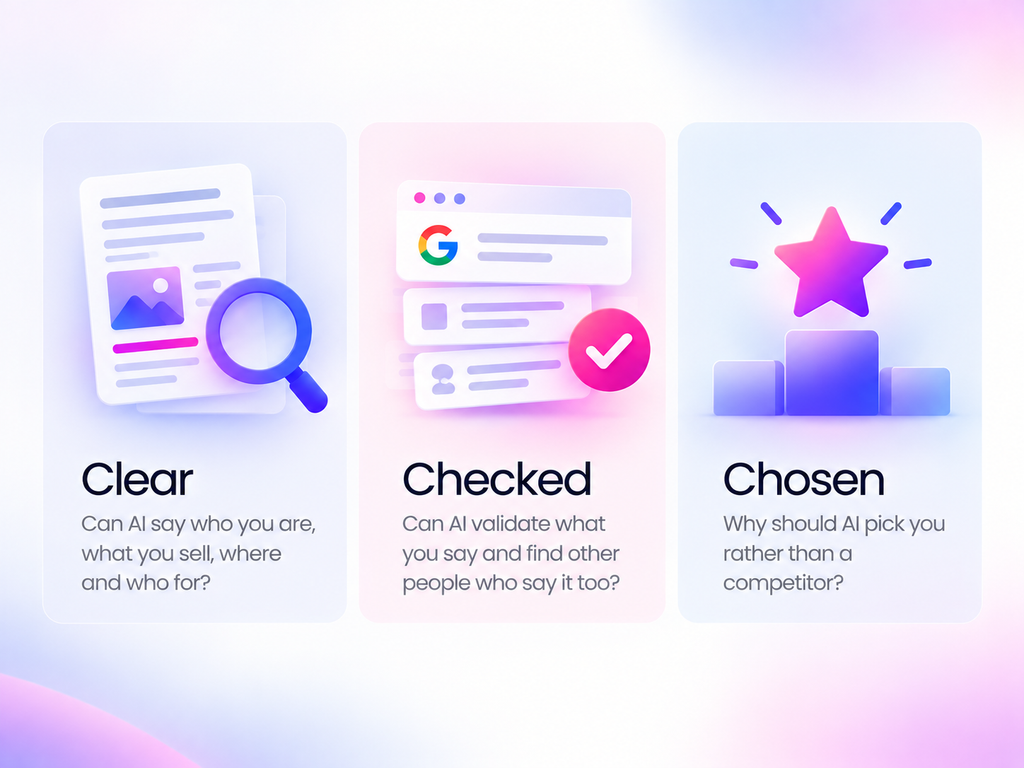
To keep it simple, I use three C’s: Clear, Checked and Chosen.
Clear: can AI say who you are, what you sell, where, and who for?
Vague wording creates vague understanding. Here’s a line like the one we used to have on our own website:
“We are passionate about delivering innovative solutions that help businesses grow.”
To me, it sounds great. It sounds like you’ll get something that changes your business. But it doesn’t say what we sell. It doesn’t even say where we are. That makes it very hard for AI to take anything from it.
Here’s the better version:
“Spark Interact is a Sydney digital agency combining brand strategy, web design and search.”
It says our name, our city and our services, all in one sentence. And remember, we’re not only writing for AI here. A person has to understand it too.
Your details have to be the same everywhere. Your business name, address and phone number should match on your website, your Google Business Profile, every directory and every listing.
Say you move office and forget to update one listing. AI might find one address in Surry Hills and another in the Sydney CBD. It gets confused, and it may give the wrong one or leave you out. The same goes for your services and your opening hours.
Build your website around the questions customers ask. A sitemap is the list of rooms in your shop. A topical map is the list of every question a customer walks in with, and which room answers it.
Go back to the physio clinic in Newtown. Customers ask things like:
- Do I need a referral?
- How much is a session?
- Physio or chiro for back pain?
- Can I claim it on private health?
Those are real questions, and each one deserves its own page. A referral page, a prices page, a physio or chiro page, a private health page. Most clinic websites just have Home, About, Services and Contact, and none of those questions has an answer.
And one tip: put a “Book an appointment” button on every one of those pages.
To sum it up: say what you sell, where you are, and who for. And say it the same way everywhere.
Checked: can AI validate what you say, and find other people who say it too?
It depends on the question, because AI looks in a different place for each one.
- A fact. “How much is a physio session in Sydney?” AI reads a few pages. One says $300, another says $400, and it gives the customer a range. That’s just information. The person asking may not be ready to book anything.
- A shortlist. “Find me the best physio in Newtown for back pain.” AI goes to a list someone else wrote, checks the list, and gives the answer. You can’t win this one on your website. You need to be on those lists.
- A check on you. “Should I go with [your business]?” This is the best one. AI goes to your website. Then it checks your reviews, what those reviews say, and what independent sources say about you. If everything lines up, it tells the customer. The person asking this question is often ready to buy.
So there’s a difference between being quoted and being recommended. Being quoted in an answer about prices is worth a lot less than AI saying “you should go with this clinic”. And for AI to recommend you, it has to validate you from many places.
That’s where backlinks and third-party mentions come in. In traditional SEO, backlinks have long been one signal of authority. With AI, the context around that mention matters too. A link or reference becomes more useful when it helps validate a specific claim about your business.
Let me explain with the researcher again.
The researcher arrives in Newtown looking for a physio. They meet a stranger.
- A link. The stranger hands them a business card and says nothing. The researcher takes the card and doesn’t know what to do with it. Is this business any good?
- A mention. The stranger says, “I know a physio clinic in Newtown. It’s right over there, you should check it out.”
- A claim. The stranger says, “I had back pain for years. I went to that clinic, and it was fixed in two sessions. You should definitely go.” That’s the power of a claim.
And who says it matters too. A recommendation from your neighbour is great. A recommendation from a trusted source, like a TV network or a university professor, carries a lot more weight.
To sum it up: can AI validate what you say, and can it find other people who say it too?
Chosen: why should AI pick you and not your competitor?
This one is really interesting. Anyone can use AI to produce content in volume. AI can write general information. But it can’t invent your experience.
You’ve worked in your industry for years. You have your own customer numbers, case studies of jobs you’ve finished, the judgement you’ve built from doing the work, your photos, your data, and the tools you use.
That’s first-party information, and AI is likely to value it more than general information that anyone can generate in a few seconds. The industry name for this is information gain. It means what your page adds that no other page has.
Think of it this way. You write a white paper about something you’ve learned in your industry. You’re the first to put this idea down, so AI may mention you as the source. That’s good.
What’s even better is when other people research the same topic, find your white paper, and link back to it as the source. And the best of all is when you become the main voice on that topic. Then, whenever someone asks about it, AI sends them back to you.
Being known is one thing. Being sent is completely different.
Imagine you have a shop in Newtown. Everyone knows it’s there. But what we want is for people to actually walk in and buy. That’s what we’re after with AI: to be the business it recommends.
To sum it up: building authority is how you build a brand in the age of AI.
What this looks like for our own site
Google Search Console now shows a report for Generative AI features. It’s still in Beta. It shows how many times Google showed your site in its AI features.
For sparkinteract.com.au, from 19 June to 8 September 2026, it shows 87.8 thousand impressions. The daily number sat between 750 and 1,500 for most of that time, and went above 2,000 in the last fortnight.
An impression isn’t a click or an enquiry. But it’s the first number Google has given us for this, and you can open the same report for your own site today.
One thing I’d add: treat all of this as one system.
You might have one team on the website, another on customer reviews, and another on social media. But AI reads all of it together. If you work on it as one project, your message and your details line up everywhere, and it’s much easier for AI to give a correct answer about your business.
How to get AI to mention you: the five S’s
Here’s a five-step framework you can start today.
- Say it. Say clearly who you are, what you sell, where, and who for. This is the first C, Clear.
- Show it. Show real jobs and real numbers. Show that you’ve done this work before, and what the outcome was.
- Structure it. Set up your website so it’s easy to find the answer to each customer question.
- Spread it. Be visible in other places. YouTube, as you saw, was 60.5% of the citations in that one industry. Focus on the channels your customers actually use, whether that’s LinkedIn, YouTube, Facebook, Instagram or somewhere else.
- Score it. Ask AI the same question you asked today, and write down the answer. Is it correct? Does it mention you at all? Then work through the steps, come back in two months, and score it again.
You can do most of this yourself:
- Say it. Write a clear statement of what your business does, and put it on your website.
- Show it. When you’ve done a great job, ask the customer for a review, and ask them what difference it made.
- Structure it. If you already have a website, see which pages or sections you can make clearer, so AI can find the answers more easily.
- Spread it. Open an account on the channels your customers use, and start publishing.
- Score it. Check once a month. It takes about four minutes.
In some areas it may make sense to get help. For example, a positioning statement that really says who you are, a website review against this framework, or a PR company if you want to appear in the big news outlets.
Back to the answer you got
Remember your answer from the start? Here’s where to begin.
- Not mentioned. Start with your own website. Say very clearly what you sell and who for.
- A competitor instead. Compare what AI is finding about them versus you. Look at your website, reviews, case studies and third-party mentions to see where their information or evidence may be stronger or clearer.
- Mentioned, but wrong. Click the links in the answer to see where AI got its information. If your business is listed wrong on another website, contact the owner and ask them to fix it.
- Mentioned, and right. Congratulations, you’re doing a great job. Check again every month or two, to make sure it stays that way.
What not to do
I’ve seen these many times, and they all come back to one idea: don’t try to trick the system.
- Don’t try to trick AI. When ChatGPT started to use Reddit as a source, a lot of people flooded Reddit with new groups, fake comments and fake discussions to get their brand mentioned. In August 2026, ChatGPT cut its Reddit citations by 73% in nine days. Whatever the reason, everyone who relied on that trick lost it in just over a week.
- Don’t make pages in bulk. With Claude, ChatGPT or Perplexity you can create a lot of pages very quickly, and so can everyone else. Be careful before you put them on your website. Google has strict spam rules for pages made in bulk, and if your website is marked as spam it can be very difficult to recover.
- Don’t write for AI only. Our goal is to get AI to mention your business more often, and more accurately. But at the end of the day, a person still has to call you or fill in your contact form. Write for that person first.
- Don’t confuse attention with sales. A tool may show that AI mentions you a lot. Look at what the questions were. Were they just looking for information, or were they ready to buy? Count enquiries and sales separately, and add “How did you hear about us?” to your enquiry form.
What matters most
AI search changes where people find information about your business, but the fundamentals are still familiar.
Be clear about what you do. Make your experience and expertise visible. Give people reasons to trust what you say, and make sure that information is consistent wherever your business appears.
The three C’s and five S’s are simply a way to put that into practice: make your business clear, checked and chosen, then say it, show it, structure it, spread it and score it.
The goal isn’t to create more content for AI. It’s to make your business easier to understand, easier to verify and easier to recommend.
Watch the full webinar: Your brand in the age of AI
Related: Brand guidelines and AI: how to keep your brand consistent